General-purpose AI agent frameworks are excellent for productivity, but enterprise security operations require stronger control boundaries. Based on our engineering experience building TARA AI, this article details five high-risk pitfalls we repeatedly encountered in production and the architecture decisions we made to address them.
Enterprise security teams are moving AI agents into daily operations, from vulnerability triage and alert correlation to workflow orchestration and report generation. The adoption curve is real, and the productivity gains are real.
Most teams begin with general-purpose agent frameworks such as Claude Code, OpenAI Agents SDK, LangChain, or Google ADK. That is a rational starting point. These ecosystems are mature, fast to prototype with, and well-documented.
The challenge appears at the boundary between prototype and production. In enterprise security environments, agents do not operate on toy data. They touch firewall policies, suppression rules, scanner APIs, ticketing systems, escalation workflows, and compliance evidence trails. In that context, the central question is no longer "can the agent complete the task?" It becomes "can the organization prove that the task was completed safely, correctly, and under control?"
This is where design targets diverge. Most generic frameworks optimize for developer productivity and capability expansion. Enterprise security operations require governance, traceability, and runtime controls for high-impact actions.
While building TARA AI, we repeatedly encountered five failure patterns that were not obvious in demo workflows but became unavoidable in production-like security operations.
Pitfall 1: The AI Executes an Action It Should Not Execute
In one internal test, we asked the agent to "clean up expired security policy configurations." The model interpreted this as deleting all rules not updated in 180 days and prepared to execute directly.
This was not a model crash and not an API error. It was a semantic overreach by an otherwise coherent planner. That distinction matters because it means conventional reliability checks do not catch it.
For high-impact operations such as firewall rule changes, suppression policy edits, identity-policy updates, or outbound notification actions, interpretation errors are expensive to undo. In regulated environments, even a successful rollback still leaves an audit and control problem.
What we changed
In TARA AI's execution engine (Apex), destructive tools require mandatory pre-execution confirmation:
- AI outputs the exact intended action and impact scope.
- The system pauses for explicit operator approval for that turn.
- Execution proceeds only after approval.
This is per-action, not blanket authorization. We intentionally avoided "approve this category forever" because category-level trust silently expands blast radius over time.
We also force action rendering in operator-facing language before approval. In practice, this means human reviewers do not confirm opaque function names. They confirm concrete intent and concrete scope.
The operational result is straightforward: execution speed is still high for low-risk tasks, while destructive actions become reviewable decision points.
Principle: AI proposes. Humans decide.
Pitfall 2: The AI Gets Stuck in a Loop and No One Notices
We tested a workflow that continuously checked a vulnerability status until remediation was confirmed. Intermittent empty API responses led the model to retry every 30 seconds for hours.
In production, loop behavior is not just cost overhead. It can flood ticketing systems, hit scanner rate limits, and block new tasks by consuming runtime context.
More importantly, loops are often "locally reasonable." Each retry can look justifiable when viewed in isolation. The failure only becomes visible when sequence-level repetition is evaluated across time.
What we changed
TARA AI's Tool Loop Guard tracks a signature per tool call (tool name + parameter summary) and monitors:
- repeated signatures above a configurable threshold,
- with no meaningful progress between calls.
When triggered, TARA pauses the turn and asks the operator to continue, revise objective, or reset.
"No meaningful progress" is evaluated using state and artifact signals, not only token generation. A model can keep producing text while system state remains unchanged. We treat that as non-progress.
This shifted loop handling from reactive interruption to proactive control. Operators see loop risk before quota exhaustion or downstream service pressure creates secondary incidents.
Pitfall 3: Audit Logs Exist, but Auditability Is Still Missing
During compliance reporting, we found that standard logs answered "what API was called" but failed to answer the questions regulators actually ask:
- who initiated the action,
- whether a human approved it,
- which decision branch caused the final outcome.
The core gap is that timeline logs and causality are different data structures. Timestamped entries can prove activity happened. They do not automatically prove why it happened, who authorized it, or how one decision led to another.
What we changed
TARA AI Runtime Audit Event Store writes strongly typed, queryable events for each action, including:
EventID,TurnID,ParentTurnIDfor decision lineage,Author(user / autonomous AI / subagent),ConfirmedBy(who approved and when),StateDeltaandArtifactDelta.
This enables compliance teams to query causality directly instead of manually reconstructing events from raw logs.
In practical terms, this supports questions such as:
- Which AI-initiated firewall changes in the last 90 days had explicit human confirmation?
- Which autonomous actions were taken by subagents under delegated scope?
- Which branch decision produced the final change ticket?
That is the difference between having logs and being audit-ready.
Pitfall 4: Long Conversations Become Slow and Expensive
Security workflows often run 20-50 turns. Sending full history every turn can push requests to 30K-50K tokens. Truncation drops needed context; full replay inflates cost and latency.
There is also a quality issue hidden inside the cost issue. As long histories accumulate large low-density payloads, model attention spreads over material with uneven relevance. Retrieval quality and planning quality can degrade even before costs become unacceptable.
What we changed
TARA AI History Compression uses a two-layer approach.
Layer 1: Sandwich compression
- Keep original user objective and latest execution state.
- Compress middle history into a structured summary.
Layer 2: Memory deposition
- Extract high-value intermediate findings into short-term and long-term memory.
- Restore continuity from memory context instead of replaying full transcript.
In our internal runs, a 50-turn workflow dropped from about 45K to about 13K input tokens per request, with continuity preserved.
The key design choice was treating compression as state management, not token trimming. If compression is implemented as blind truncation, continuity breaks. If compression preserves objective, latest state, and high-value findings, continuity survives while request size drops sharply.
Pitfall 5: Single-Provider LLM Dependency Becomes an Operational Risk
We observed two recurring problems in single-provider deployments:
- provider outages interrupting production workflows,
- migration friction when another model performs better for specific task types.
In enterprise environments, this is not a theoretical concern. Reliability, pricing changes, policy constraints, and model-specific capability differences all become operational variables over time.
What we changed
TARA AI's provider layer supports:
- hot switching default provider at runtime,
- per-module provider assignment,
- automatic light/heavy routing by request complexity.
Compared with always-on GPT-4-class usage, intelligent routing reduced LLM spend by 40-60% in our measured workloads and improved latency for lightweight requests.
Per-module assignment matters in practice. Main planning can run on a stronger model, while summarization and memory extraction can run on lower-cost models under strict validation. This keeps quality where it is needed and cost where it can be controlled.
Hot switching at runtime also turns provider incidents into manageable degradation events rather than full workflow outages.
The Core Mismatch
These pitfalls all stem from one mismatch: general agent frameworks optimize for capability expansion, while enterprise security operations require capability inside enforceable control boundaries.
These goals are not in conflict, but they produce different engineering priorities. In low-risk workflows, prompt-level controls may be sufficient. In high-impact security operations, they are not.
Controls such as pre-execution confirmation, loop detection, and causal auditability must be runtime-native mechanisms with explicit state, explicit ownership, and explicit operator visibility.
That is a core design choice behind TARA AI.
Enterprise AI Agent Readiness: 5 Questions
Before production rollout, ask:
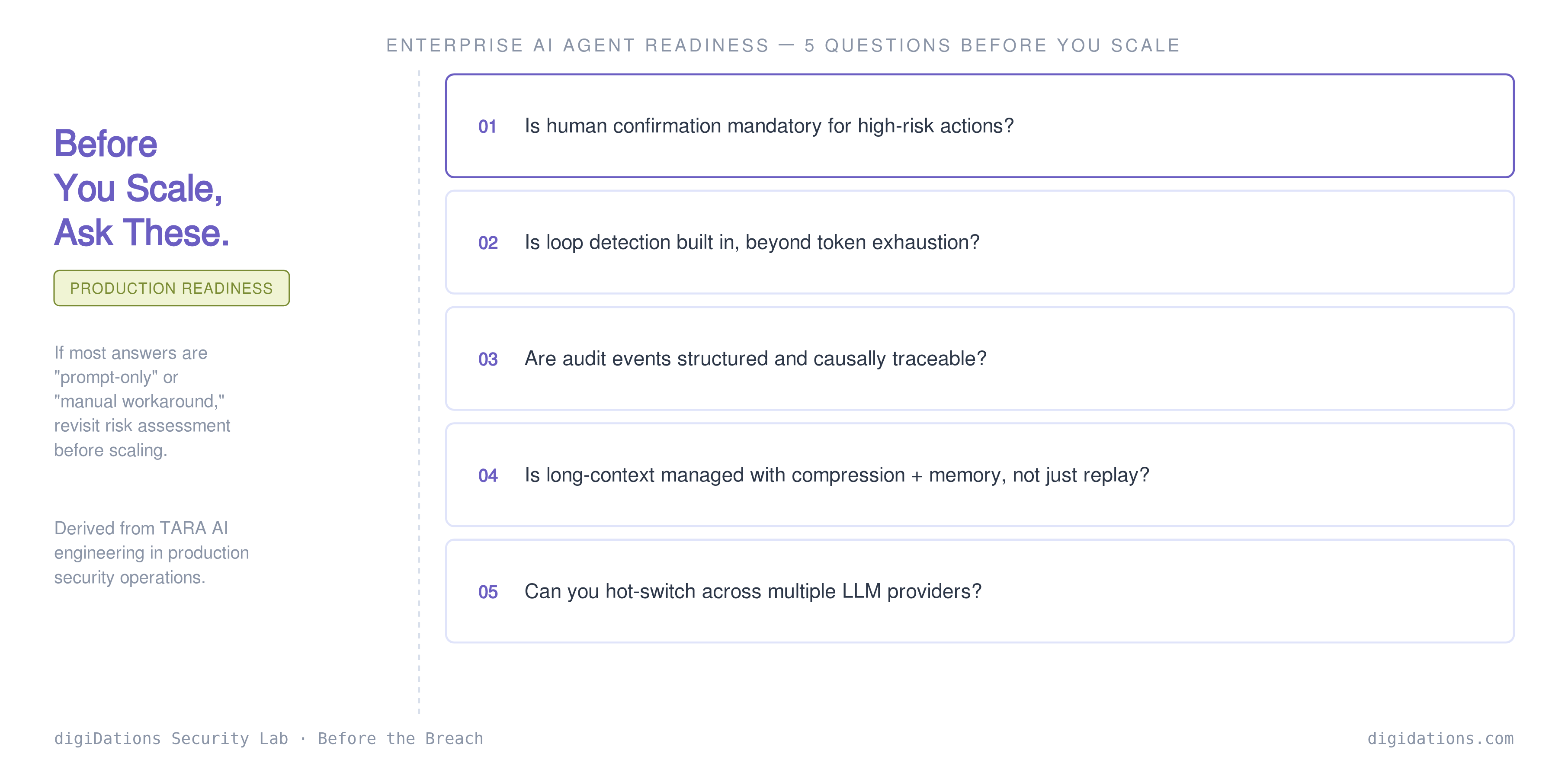
- Is human confirmation mandatory for high-risk actions?
- Is loop detection built in, beyond token exhaustion?
- Are audit events structured and causally traceable?
- Is long-context handling intelligent (compression + memory), not only replay or truncation?
- Can you hot-switch across multiple LLM providers?
If most answers are "prompt-only" or "manual workaround," risk assessment should be revisited before scaling.
These five questions do not prescribe one architecture. They do provide a practical minimum bar for evaluating whether an agent stack is production-ready in security operations.