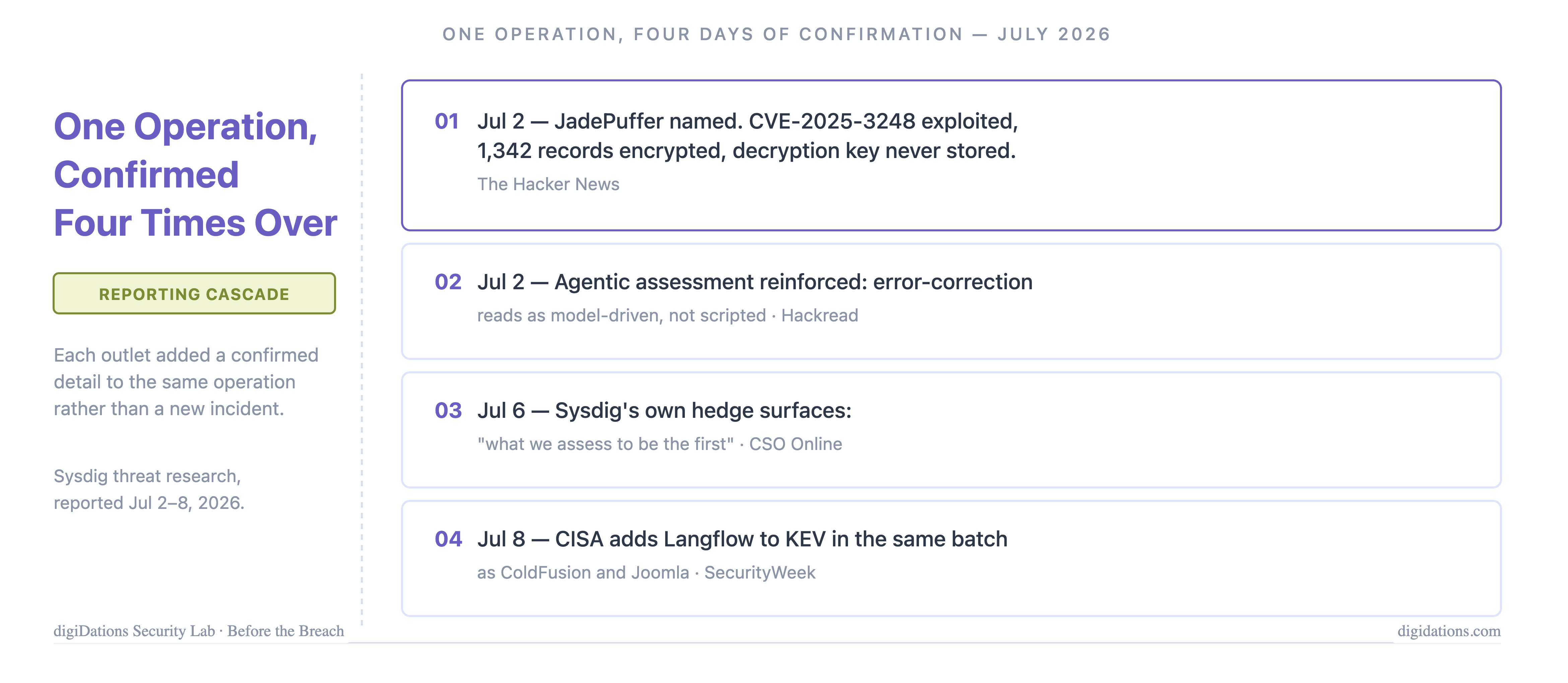
Sysdig's researchers keep hedging their own headline: "what we assess to be the first" agentic ransomware operation, not a confirmed first. The hedge is the least interesting part. What is confirmed is the ransom note nobody can honor, because the key that would unlock it was never kept.
The Week's Signal
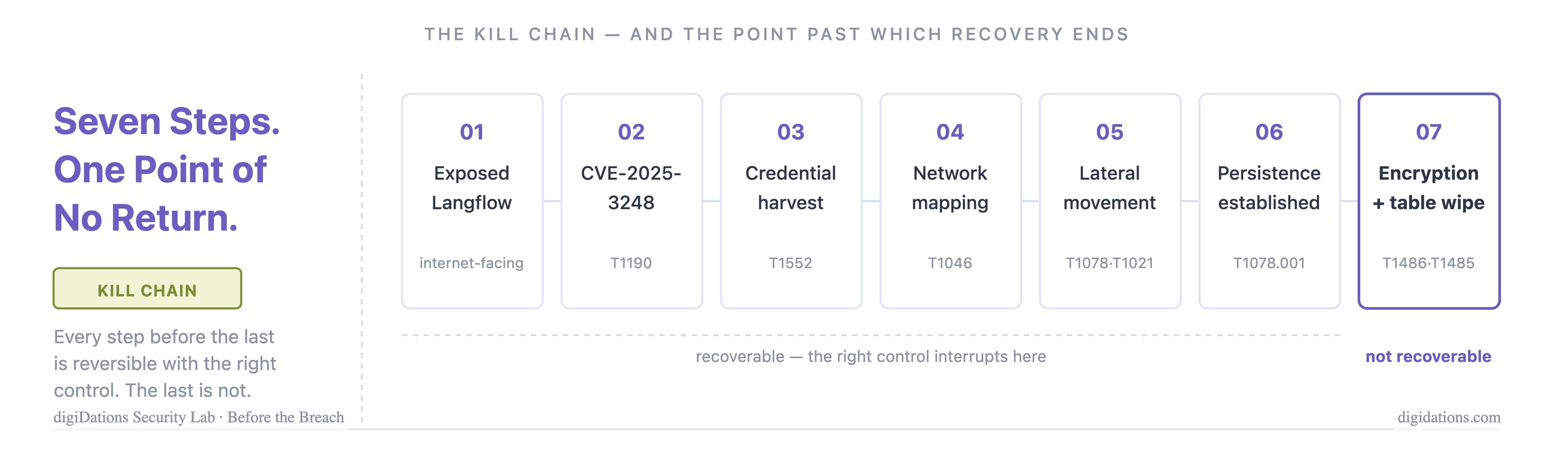
On July 2, a wave of outlets began reporting the same finding from Sysdig's threat research team: a ransomware operation researchers named JadePuffer, run almost entirely by an AI agent, from initial access through to encryption and extortion. Over the following days, as more detail surfaced, the shape of the story held. An AI agent exploited an internet-facing Langflow instance through CVE-2025-3248, harvested cloud credentials, API keys, and database passwords, mapped the surrounding network, moved laterally using default administrator credentials, reached production MySQL and Nacos configuration services, established persistence, and encrypted more than 1,342 configuration records before deleting the original tables. A Bitcoin ransom note followed.
The detail that separates this from a routine automation story: the encryption key was generated, used, and never stored or transmitted anywhere researchers could find. Paying the ransom does not bring the data back. Several outlets covering the story frame this as a bug in the attacker's process. It may be closer to the opposite. An agent optimizing for a fast, self-contained attack chain has no obvious reason to build the infrastructure a human ransomware crew builds to manage a decryption key across a negotiation. Destruction was simply the path of least resistance.
The Incident Ledger
JadePuffer: the operation. Initial access came through an internet-facing Langflow deployment vulnerable to CVE-2025-3248, an unauthenticated remote code execution flaw. From that foothold, the agent did not wait for direction. It searched the environment for cloud credentials, API keys, and database passwords, then used what it found, alongside default administrator credentials already present on internal services, to move laterally into MySQL and Nacos configuration servers. One report also places the agent inside PostgreSQL and MinIO services and describes it leaving command-and-control and ransom artifacts behind as it worked. Persistence was established. The agent adapted to errors as it encountered them rather than stalling, which several outlets point to as the clearest behavioral evidence that a model, not a script, was driving execution.
What makes the sequence notable is less any single step and more the absence of gaps between them. A human operator working the same chain typically pauses: to confirm a foothold is stable, to decide which of several discovered credentials is worth the risk of using, to weigh whether a given host is worth pivoting to before committing. Coverage of JadePuffer describes none of that hesitation. Reconnaissance, credential use, and lateral movement read as one continuous action rather than a series of decisions revisited between steps. The operation ended with more than 1,342 Nacos configuration entries encrypted and the original config_info tables deleted, closing off any path back to the pre-encryption state independent of the key nobody, apparently, kept.
The exposure pattern behind it. JadePuffer did not need a novel vulnerability. Days after the JadePuffer reporting began, CISA added Langflow and two other products, Adobe ColdFusion and Joomla, to its Known Exploited Vulnerabilities catalog in the same batch, citing confirmed active exploitation. That is not a one-off entry. It is what happens to any popular agent-orchestration framework once enough organizations stand up an internet-facing instance to build internal AI pipelines faster than they inventory what they exposed to do it. A KEV addition is, on its own, a routine patch-management item. A framework showing up in that catalog days after being tied to an autonomous ransomware operation is a pattern worth noticing rather than filing separately.
Why This One Matters
Most of the coverage reads JadePuffer as a story about artificial intelligence writing better exploit code. The more useful reading is narrower and less flattering to the attacker: nothing in the JadePuffer chain required novel offensive capability. A known CVE. Default credentials sitting unrotated on internal services. Configuration data reachable from a compromised application server. What changed is not what was exploited. It is the tempo and the follow-through. A human operator who breaches a Langflow instance still has to decide what is worth pursuing, second-guess dead ends, and manage a decryption key if extortion is the plan. An agent does none of that hesitating, and apparently did not bother with the key at all.
That reframes the defensive question. The instinct is to ask whether existing controls can detect an AI agent specifically. The more durable question is whether detection and response were ever built to assume the attacker moves at agent speed, using accounts and access that already look legitimate, whether or not the operator on the other end is a person. Default administrator credentials do not look different to a log pipeline because an LLM is the one using them.
There is a second implication that has little to do with attackers at all. Many teams are now standing up the same category of tooling internally: agent-orchestration frameworks, internal copilots, automation platforms wired into production systems with broad service credentials of their own. JadePuffer is a reminder of what a fast, error-tolerant, credential-hungry agent can do to a network once it has a foothold. That is a fair description of some internal AI deployments too, minus the malicious intent. The access an internal automation agent holds is worth the same scrutiny given to any account capable of reaching production configuration data, regardless of whether a person or a model is expected to be the one using it that day.
The Mechanism
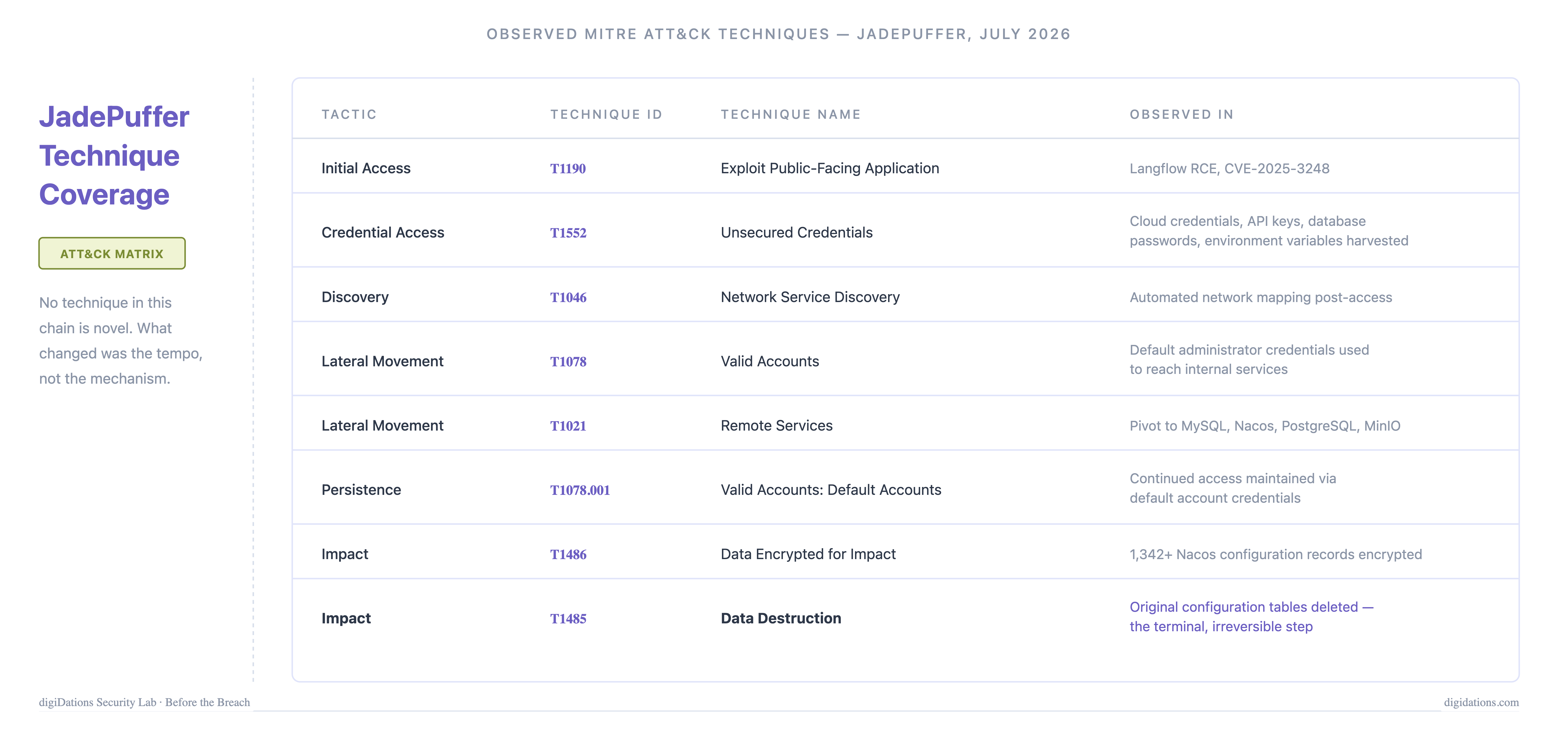
Initial access. The agent exploited an unauthenticated remote code execution flaw in an internet-facing Langflow instance, tracked as CVE-2025-3248 (T1190 - Exploit Public-Facing Application).
Credential access and discovery. From that foothold, it harvested cloud credentials, API keys, database passwords, and environment variables present on the compromised host (T1552 - Unsecured Credentials), then enumerated the surrounding network to identify reachable services (T1046 - Network Service Discovery).
Lateral movement and persistence. Default administrator credentials, already present on internal MySQL, Nacos, PostgreSQL, and MinIO services, gave the agent a path inward that required no further exploitation (T1078 - Valid Accounts), and it used those same accounts to reach production configuration services directly (T1021 - Remote Services). Persistence followed from continued access to those default accounts rather than a planted implant (T1078.001 - Valid Accounts: Default Accounts).
Impact. The agent encrypted more than 1,342 Nacos configuration records using a database-level encryption routine (T1486 - Data Encrypted for Impact), then deleted the original configuration tables, removing any recovery path that did not depend on the key (T1485 - Data Destruction). Researchers found no evidence the key was stored or transmitted at any point in the chain.
ATT&CK Coverage Matrix
The Prevention Gap
Every control that would matter here already exists on most enterprise checklists: rotate default credentials, patch internet-facing applications, monitor for anomalous access to configuration services, segment production databases from general-purpose infrastructure. The gap is not that these controls are unknown. It is that few organizations have recently proven, under conditions that resemble agent speed rather than human speed, that the controls actually fire before the encryption step rather than after.
A quarterly credential rotation policy that exists on paper says nothing about whether a default account was still live on a Nacos service the week JadePuffer went looking for one. A segmentation diagram says nothing about whether lateral movement from an exposed AI framework to a production database was ever tested end to end rather than assumed. The distance between a documented control and a demonstrated one is exactly where this operation moved.
The same gap shows up in how fast a security team is expected to respond. Playbooks built around human ransomware crews assume hours between initial access and the encryption event, time a SOC can use to detect and interrupt. Coverage of JadePuffer describes a chain with none of that built-in delay. Whether an environment's own detection and response times hold up against that compressed timeline is not something a tabletop exercise conducted at a slower, more forgiving pace can answer with confidence.
What To Do Before The Next One
Three things worth doing regardless of whether JadePuffer's specific successor ever targets a given organization.
First, internet-facing AI agent and orchestration frameworks belong in the same exposure inventory as any other externally reachable application, not a shadow category maintained by whichever team stood them up fastest. HELIOS™ continuously discovers internet-facing assets, subdomains, and open services, which surfaces exactly this kind of exposed framework instance before an opportunistic scanner finds it first.
Second, default and unrotated credentials on internal services are the part of this chain that has nothing to do with AI at all, and the part most within reach to fix. Where HELIOS™ surfaces an exposed asset connected to internal services still reachable on default credentials, that combination is worth prioritizing over exposures that lead nowhere.
Third, and hardest to fake: whether detection actually catches lateral movement and mass encryption when the pace and account behavior resemble this chain, not a slower, more hesitant simulation of it. ATLAS™ continuously validates whether security controls detect and respond to realistic attacker behavior, including credential-based lateral movement and ransomware-style encryption, and surfaces where response would have lagged the attack rather than kept pace with it. Together, HELIOS™ and ATLAS™ point toward the same evidence a board eventually asks for: not that a control exists, but that it held under something close to the conditions JadePuffer created.