The control was the way in. Four security products drew urgent action in the space of a fortnight, and in each case the vulnerable component was infrastructure bought to prevent exactly this kind of compromise. Only one of the four comes with a publicly evidenced exploitation window that predates its disclosure, and that one is worth reading twice.
The Week's Signal
Start with the interval, because it is the only number here that cannot be patched.
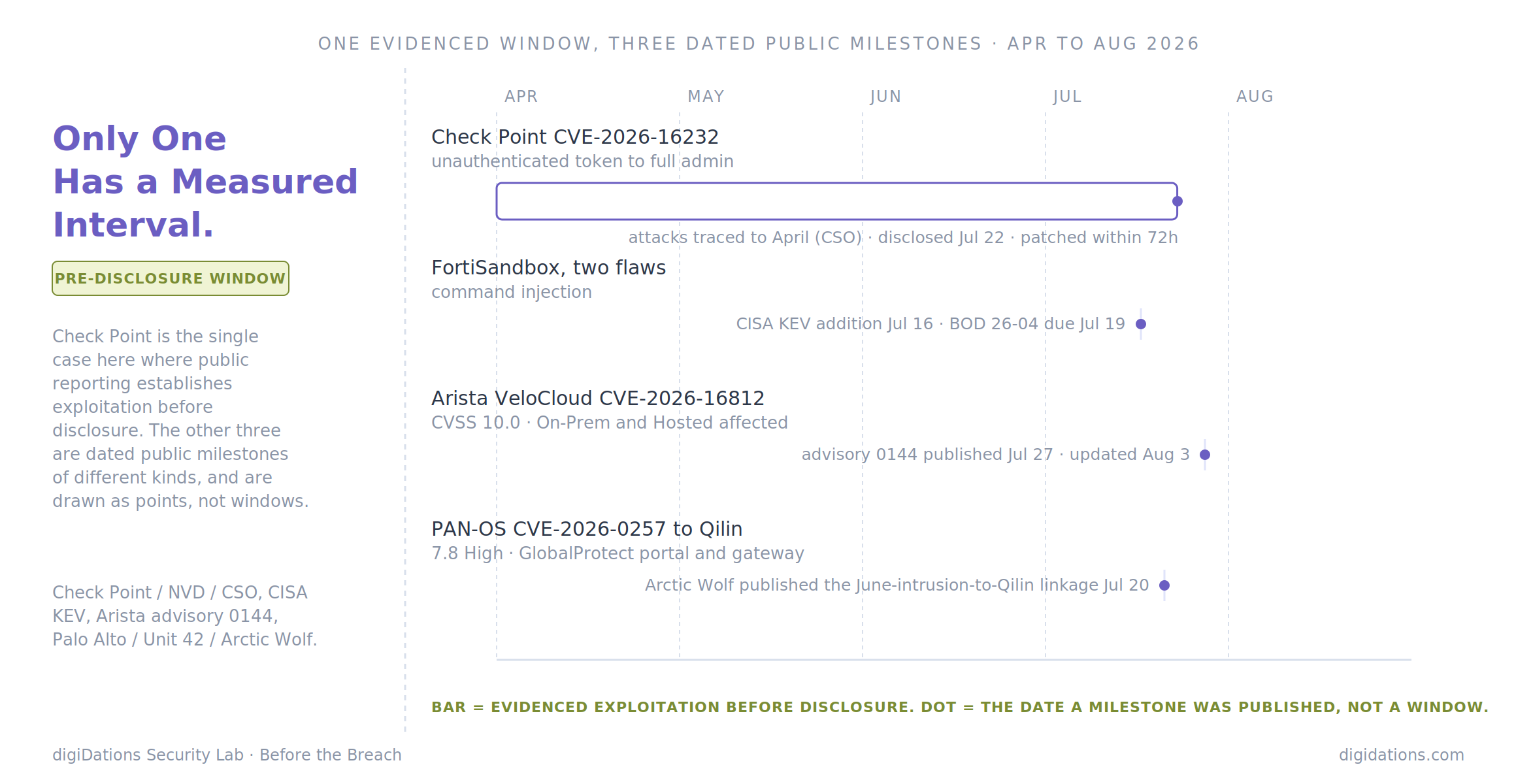
On July 22, 2026, Check Point disclosed CVE-2026-16232, a flaw allowing unauthenticated acquisition of an application login token and, from there, full administrative access to security management. Check Point and NVD both describe remote exploitation as conditional: it requires internet access to the Management Server and the absence of a Trusted Clients restriction. Check Point said a handful of customers were affected. The patch shipped within 72 hours, which is a fast response by any standard. CSO then reported that the company traced attacks back to April 2026. Three months of exploitation, and a remediation clock that only started in July.
Three other security products drew action over the same period, each on a different mechanism. On July 16, CISA added two FortiSandbox command-injection vulnerabilities to the Known Exploited Vulnerabilities catalog under Binding Operational Directive 26-04, with a remediation due date of July 19. On July 27, Arista published security advisory 0144, assigning CVE-2026-16812 with a CVSS score of 10.0 to a flaw in VeloCloud Orchestrator; the advisory was updated on August 3 and states that both On-Prem and Hosted deployments are affected, with Hosted and Dedicated versions being actively patched. And Palo Alto Networks rates CVE-2026-0257 at 7.8, High, affecting the GlobalProtect portal and gateway under specific configuration conditions; Unit 42 and Arctic Wolf Labs have both documented active exploitation, and Arctic Wolf tied a set of June intrusions to Qilin ransomware deployed later.
Four vendors. Four different mechanisms. One asset class: the security infrastructure itself, rather than the assets it protects.
The Incident Ledger
Check Point, CVE-2026-16232, disclosed July 22, 2026. The compromised object is security management, not any individual enforcement point. Initial access is the acquisition of an application login token without authentication, after which the attacker completes login through the normal administrative path (T1190 - Exploit Public-Facing Application, T1550.001 - Use Alternate Authentication Material: Application Access Token). The token is the mechanism worth noting, because a session established with valid authentication material is not an anomalous login in any log that records only success and failure. Two preconditions govern remote exploitability, and they are the useful part for a defender: the Management Server must be reachable from the internet, and no Trusted Clients restriction can be in place. That is an exposure question and a configuration question, both answerable in advance. From the administrative position reached, the documented capability is modification of security policies and configurations, which is the ability to change what the estate's controls do rather than to evade them (T1562.001 - Impair Defenses: Disable or Modify Tools, as documented capability rather than reported action). Check Point said a handful of customers were affected, shipped a patch within 72 hours, and CSO reported the company subsequently traced attacks to April 2026.
FortiSandbox, two command-injection flaws, KEV catalog July 16, 2026. These entered CISA's Known Exploited Vulnerabilities catalog under Binding Operational Directive 26-04, with federal agencies given until July 19 to remediate. The mechanism is command injection (T1190 - Exploit Public-Facing Application, T1059 - Command and Scripting Interpreter). What makes this one instructive is the identity of the appliance rather than the severity of the flaw. FortiSandbox exists to detonate and analyse suspicious files. It is, by design, a system that receives untrusted input from across the organisation and executes it in a controlled way. A command-injection flaw in a product whose entire function is handling hostile content is a different proposition from the same flaw in a general-purpose server, because the delivery path to it is the one the organisation deliberately built. Worth being precise on the regulatory mechanism too: a KEV addition with a BOD 26-04 due date is a standing directive being applied to newly catalogued CVEs, not a separately issued emergency directive.
Arista VeloCloud Orchestrator, CVE-2026-16812, CVSS 10.0. Advisory 0144 was published on July 27 and updated on August 3. VeloCloud Orchestrator is the management plane for an SD-WAN deployment, and the reported flaw is an unauthenticated command injection permitting a remote attacker to reach privileged internal functionality and affect the host (T1190 - Exploit Public-Facing Application, T1059 - Command and Scripting Interpreter). The blast radius is structural rather than incidental: control of the orchestrator is control of the Edge devices connected to it. Per the current advisory, both On-Prem and Hosted deployments are affected, with Hosted and Dedicated versions being actively patched. This is a moving picture. An issue drafted a week earlier would have described a different remediation state, which is itself a reason to check the vendor advisory rather than the coverage before acting on any of this.
Palo Alto Networks PAN-OS, CVE-2026-0257, and Qilin. Palo Alto rates this 7.8, High, affecting the GlobalProtect portal and gateway under specific configuration conditions (T1190 - Exploit Public-Facing Application, T1133 - External Remote Services). Unit 42 and Arctic Wolf Labs have both documented active exploitation, and Arctic Wolf connected a series of June intrusions to Qilin ransomware deployed subsequently (T1486 - Data Encrypted for Impact). The score is the interesting part. A 7.8 does not clear the threshold at which many programmes trigger out-of-band remediation, and it sits below every other flaw in this ledger. It nonetheless functioned as the front door to ransomware. Severity scores describe the vulnerability. They do not describe what the position it grants is worth to an operator who knows what to do next.
Why This One Matters
The obvious reading is that security vendors ship vulnerable code. That reading is true, unremarkable and not useful. Every vendor ships vulnerable code, including the ones absent from this fortnight's news, and a programme built on selecting vendors that do not is not a programme.
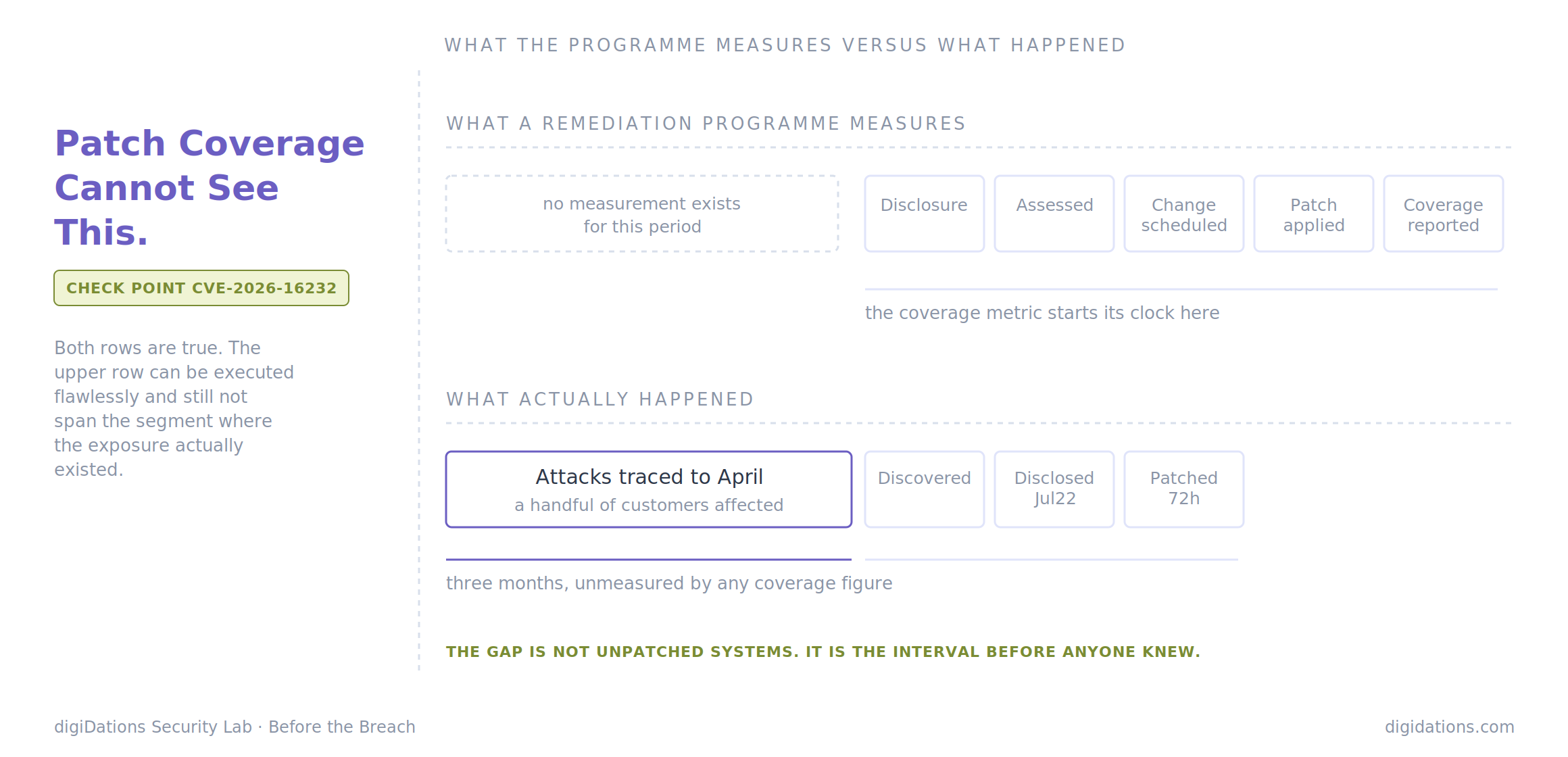
The reading that changes something is about the interval, and Check Point is the one case here where the public record actually supports it. Consider what a well-run remediation programme does. Disclosure lands. Severity is assessed. The asset is located, the change is scheduled, the patch is applied, coverage is reported. That process can be executed flawlessly, and its performance is measured from the disclosure date. Everything before the disclosure date is invisible to it, including the exploitation CSO reports Check Point traced to April.
This is why patch coverage and control assurance are different measurements, and why one cannot substitute for the other. Coverage answers whether the fixes you were told about were applied, and how quickly. It is a real and necessary metric. It says nothing about the window in which a flaw was in use and nobody had been told. During that window the only thing standing between an organisation and the outcome is whether anything in the environment would have noticed the resulting activity: an administrative session established with a token nobody issued, a policy modification nobody scheduled, a command executing on an orchestrator host.
There is a second-order version that applies specifically to security infrastructure, and the four cases here divide along it. Two are management planes. Check Point's Management Server and Arista's VeloCloud Orchestrator both administer other controls, which means compromise there is not evasion of a control but authorship of it. These systems are also frequently the least monitored in the estate, for reasons that once made sense: they are administrative, accessed by a small trusted group, and they generate the logs rather than appearing in them. Two are appliances in the traffic path. FortiSandbox and the GlobalProtect portal and gateway sit where hostile input arrives by design. The organisation built the delivery route deliberately, and a flaw in the receiving component turns that route into an entry path rather than a control point. Neither category is exotic. Both are usually excluded from the exposure scope applied to ordinary application servers, on the reasoning that they are security infrastructure and therefore the thing doing the securing.
The Mechanism
Across the four, the path is consistent enough to describe once.
Reach a security component rather than the asset it protects. Every one of these is an unauthenticated flaw on a product bought as a control: a management server, an orchestrator, an analysis appliance, a VPN portal and gateway (T1190 - Exploit Public-Facing Application, T1133 - External Remote Services).
Arrive already privileged, or already executing. None of these chains requires a conventional privilege-escalation stage. Check Point's token acquisition yields administrative access through the ordinary login path (T1550.001 - Use Alternate Authentication Material: Application Access Token). The FortiSandbox and VeloCloud flaws are command injection, which is execution on the host as the first act rather than a later one (T1059 - Command and Scripting Interpreter).
Act as the platform. From that position the available actions are the product's own. This is the step conventional detection handles worst, because the activity is generated by the trusted system and appears in logs as ordinary administration (T1562.001 - Impair Defenses: Disable or Modify Tools).
Convert access to outcome. In the Qilin case the conversion is documented and the interval between the two is short: exploitation of the GlobalProtect portal and gateway in June, ransomware deployment after (T1486 - Data Encrypted for Impact). For the others the outcome is not publicly enumerated, and this issue does not assume one.
Analytical ATT&CK Mapping
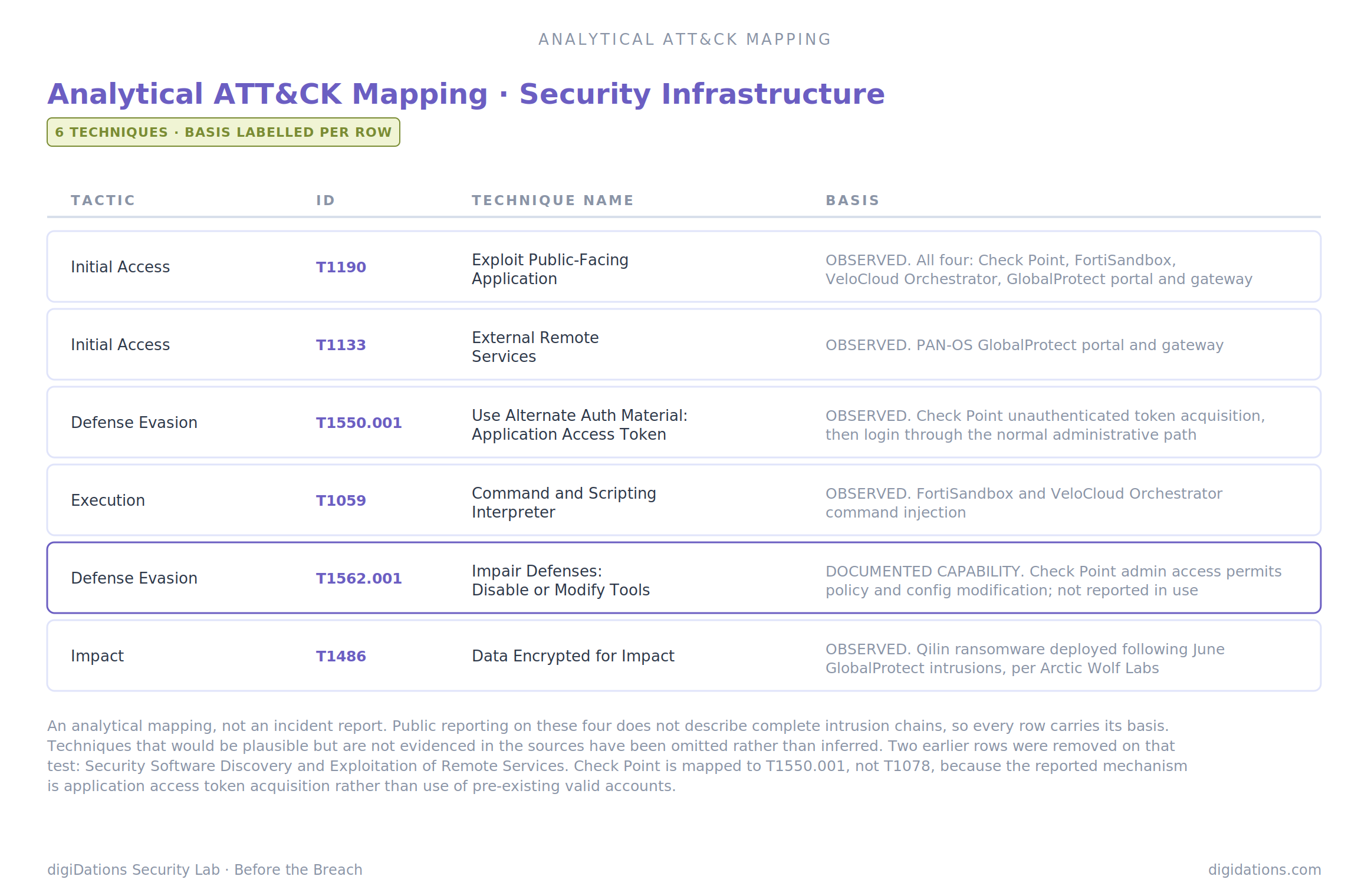
This table is an analytical mapping, not an incident report. Public reporting on these four does not describe complete intrusion chains, so each row is labelled with its basis: observed where the source describes the behaviour as having occurred, documented capability where the source establishes what the flaw permits without reporting it in use. Techniques that would be plausible but are not evidenced in the sources have been left out rather than inferred.
The Prevention Gap
The gap is not that these systems went unpatched. In several of these cases the patch was available quickly and applied quickly. The gap is that security infrastructure is usually excluded from the two things that would have mattered during the window before anyone knew.
It is frequently excluded from exposure scope, because it is understood as the thing doing the securing. Check Point is the sharpest illustration, because its own preconditions are exposure questions: was the Management Server reachable from the internet, and was a Trusted Clients restriction in place. Both were answerable before July 22 by anyone who had asked. Arista is the version that keeps moving, since an advisory published July 27 and revised August 3 means the remediation state on any given orchestrator depends on when someone last looked.
It is also frequently excluded from detection scope. Administrative logins to a security console, policy changes and configuration modifications are ordinary events in a system whose purpose is to receive them. Without a specific expectation of what normal looks like on that plane, a malicious administrative session crosses no threshold. The Check Point mechanism sharpens this: a session opened with a validly acquired token is not a failed login, not a brute force, and not an anomaly in any control that watches authentication outcomes rather than authentication provenance.
Neither exclusion is unreasonable in isolation. Together they produce systems that are critical, reachable, privileged and unwatched. The question a board will eventually ask is not whether the organisation patched quickly. It is what would have happened in April, and whether anything would have been seen. That question has an evidence-based answer or it has an assumption.
What To Do Before The Next One
Bring security infrastructure into exposure scope explicitly, and treat the vendor's own preconditions as your checklist. Not just the enforcement devices, which are usually counted, but management servers, SD-WAN orchestrators, analysis appliances, and VPN portals and gateways. Check Point published exactly what to check: internet reachability of the Management Server, and whether a Trusted Clients restriction is configured. That is a better starting point than a severity score, because it is specific to your deployment rather than to the flaw.
Read the vendor advisory, not the coverage, and read it again. Arista's advisory 0144 changed materially between July 27 and August 3, including which deployment types are affected and which are being patched. Any remediation decision made from a summary written in between those dates was made against a picture that no longer holds.
Define what normal looks like on the management plane, and alert on provenance rather than outcome. Administrative logins outside expected windows, policy modifications with no corresponding change record, and sessions established from tokens with no issuing event are all detectable without knowing which vulnerability produced them. That matters precisely because the pre-disclosure window is defined by not knowing what to look for.
Assume the edge-to-ransomware path and check where it would be interrupted. The Qilin chain runs from a 7.8-rated flaw on a GlobalProtect portal and gateway to ransomware deployment. The useful exercise is not predicting the entry vulnerability, and certainly not ranking it by score. It is establishing which steps between initial access and encryption would produce a signal today, and which would not.
That last question is one the digiDations portfolio was built to answer with evidence rather than inference. HELIOS™ continuously discovers internet-facing assets across domains, subdomains, certificates, service fingerprints and open ports, with minute-level change detection, which surfaces management interfaces that entered the estate without a record and flags the moment one becomes reachable. That is the same question Check Point's precondition asks, asked continuously instead of once. ATLAS™ then measures whether the deployed controls respond: it executes realistic attacker behaviour, including full ransomware execution inside the ACL-isolated containment of its Isolator component with post-test snapshot rollback, and compares what the security stack actually reported through its Log Gateway against what was run. The output is evidence of which behaviours were prevented, which were detected, which passed without a signal, and Sigma and Suricata rules for the gaps. Ransomware defence validation is the use case ATLAS was designed around first, which makes the Qilin chain a direct fit.