Microsoft's account of a Zimbra compromise shows the foothold becoming a hunt for stored credentials, directory keys, mailbox data and backups. One attempted transfer is not confirmed complete.
The Week's Signal
On September 30, Microsoft Threat Intelligence published its account of exploitation of CVE-2026-73570 in Zimbra Collaboration Suite. Microsoft says affected organizations spanned more than one region and industry. Its investigation follows the activity beyond initial access, into credential theft and access to mailbox databases and backup content.
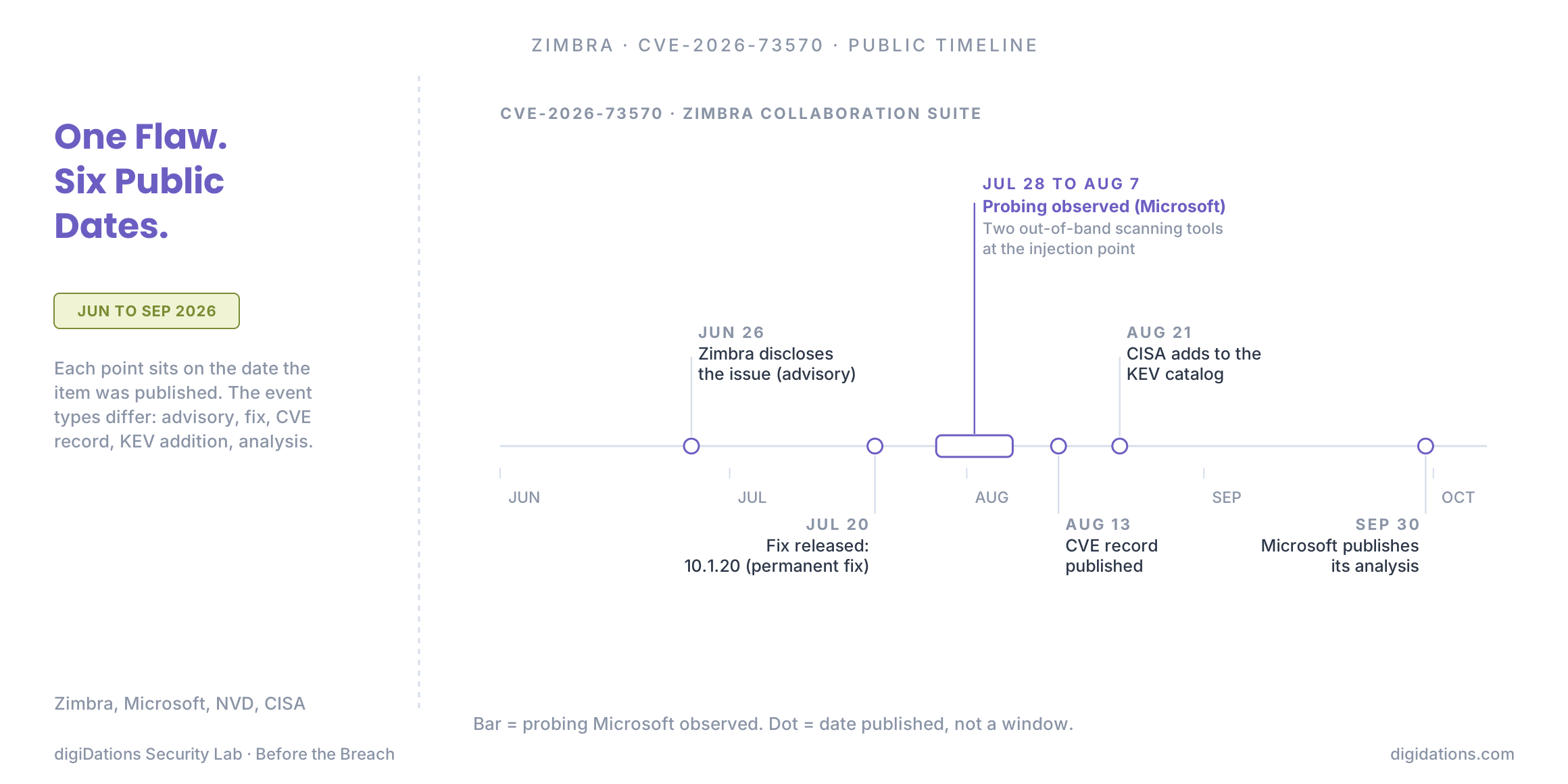
The timeline starts earlier. Zimbra disclosed the issue on June 26. Version 10.1.20, the permanent fix, was released July 20. Microsoft observed two out-of-band scanning tools probing the injection point between July 28 and August 7. The CVE record was published August 13, and CISA added it to the Known Exploited Vulnerabilities catalog on August 21.
The critical detail is what the actor did after the initial foothold. The vulnerability allowed unauthenticated command execution as the Zimbra service account; the investigation documents the actor moving from that access to credentials and mail data stored on the server.
The Incident Ledger
Zimbra Collaboration Suite, CVE-2026-73570. The vulnerability is in SNMP notification processing. When the optional zimbra-snmp package is installed and SNMP notifications are enabled, a crafted SMTP request can trigger unauthenticated remote code execution as the Zimbra user. The CVE record scores it 8.9. Zimbra's security advisory list identifies 10.1.20 as the fix.
Microsoft reports two out-of-band scanning tools probing the injection point from July 28 to August 7. It also documents JSP web shells written to publicly accessible application directories (T1505.003 - Server Software Component: Web Shell) and a systemd service named zimlog.service, with timestamps altered to resemble existing units (T1543.002 - Create or Modify System Process: Systemd Service).
A Zimbra-specific implant read /opt/zimbra/conf/localconfig.xml, where LDAP, MySQL and other service-account passwords are stored (T1552.001 - Unsecured Credentials: Credentials In Files). Using recovered credentials, the actor queried LDAP for zimbraPreAuthKey, zimbraAuthTokenKey and zimbraTwoFactorAuthSecret. Microsoft says the actor exported the mailbox, mailbox_metadata, mobile_devices and out_of_office tables, along with data in the zimbra database namespace (T1213.006 - Data from Information Repositories: Databases).
On one server, the actor archived recent mailbox-backup content to /opt/zimbra/final.tar.gz and invoked AzCopy against an Azure Blob URL. Microsoft says the available evidence does not confirm that the transfer completed successfully. It provides no victim count and names no actor.
The vulnerability was disclosed June 26; Zimbra 10.1.20, identified as the permanent fix, was released July 20. The public CVE record followed on August 13, and CISA added it to KEV on August 21. See the NVD record, Zimbra security advisories and CISA KEV entry.
Why This One Matters
Microsoft's report exposes unusually specific forensic details: the configuration file read, credentials sought, LDAP queries, database tables accessed and backup archive created. The artifacts are Microsoft's; our value is translating this kind of threat intelligence into realistic behaviors and sequences that can be exercised in a security-validation platform. The breadth of a validation library determines how much attacker behavior customer controls can be tested against, while detailed reporting helps ground those scenarios in observed activity. In this case, the sequence also makes the server's stored credentials and the services they unlock part of the incident scope.
The limits matter just as much. Microsoft does not give a victim count or identify an actor, and it does not confirm that the AzCopy transfer completed. The reporting establishes access, collection and attempted transfer; it does not establish successful exfiltration or the full impact across affected organizations.
The scope here is one Zimbra incident. The observed actions should not be generalized to every Zimbra customer or to mail systems as a class.
The Mechanism
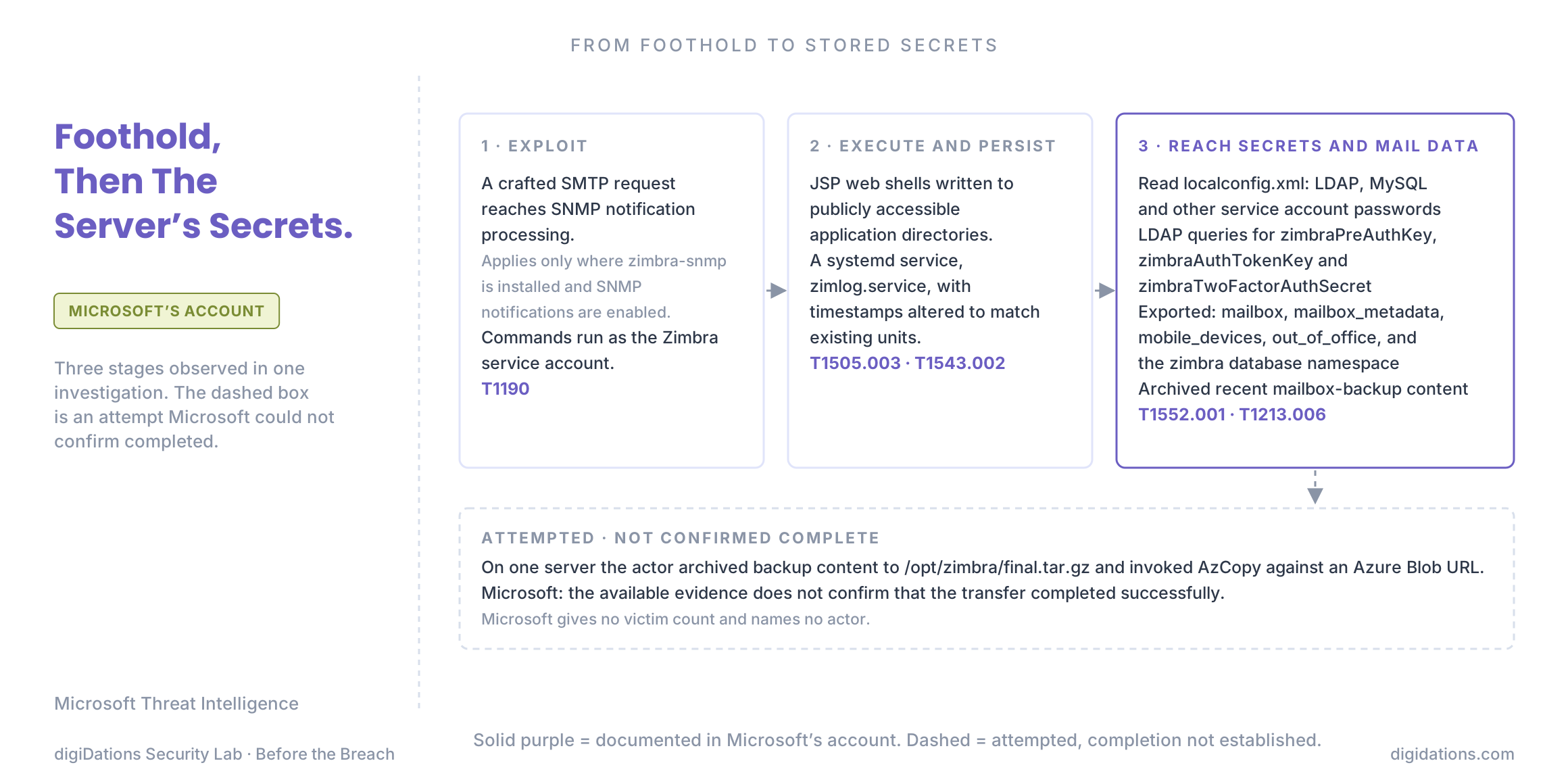
Microsoft's reporting supports three stages in this case:
1. Exploit the exposed Zimbra service. A crafted SMTP request reaches the SNMP notification path on a server with the optional package installed and notifications enabled (T1190 - Exploit Public-Facing Application).
2. Establish execution and persistence. The flaw allows commands as the Zimbra user. Microsoft observed JSP web shells and the zimlog.service systemd unit (T1505.003, T1543.002).
3. Use the host to reach stored secrets and mail data. The implant read service credentials from localconfig.xml, queried LDAP for authentication keys and secrets, and exported named mailbox tables (T1552.001, T1213.006). Backup data was archived locally; the subsequent AzCopy transfer is not confirmed complete.
These are observed actions in Microsoft's account. The Azure transfer is an attempted exfiltration, not a confirmed successful one.
ATT&CK Mapping
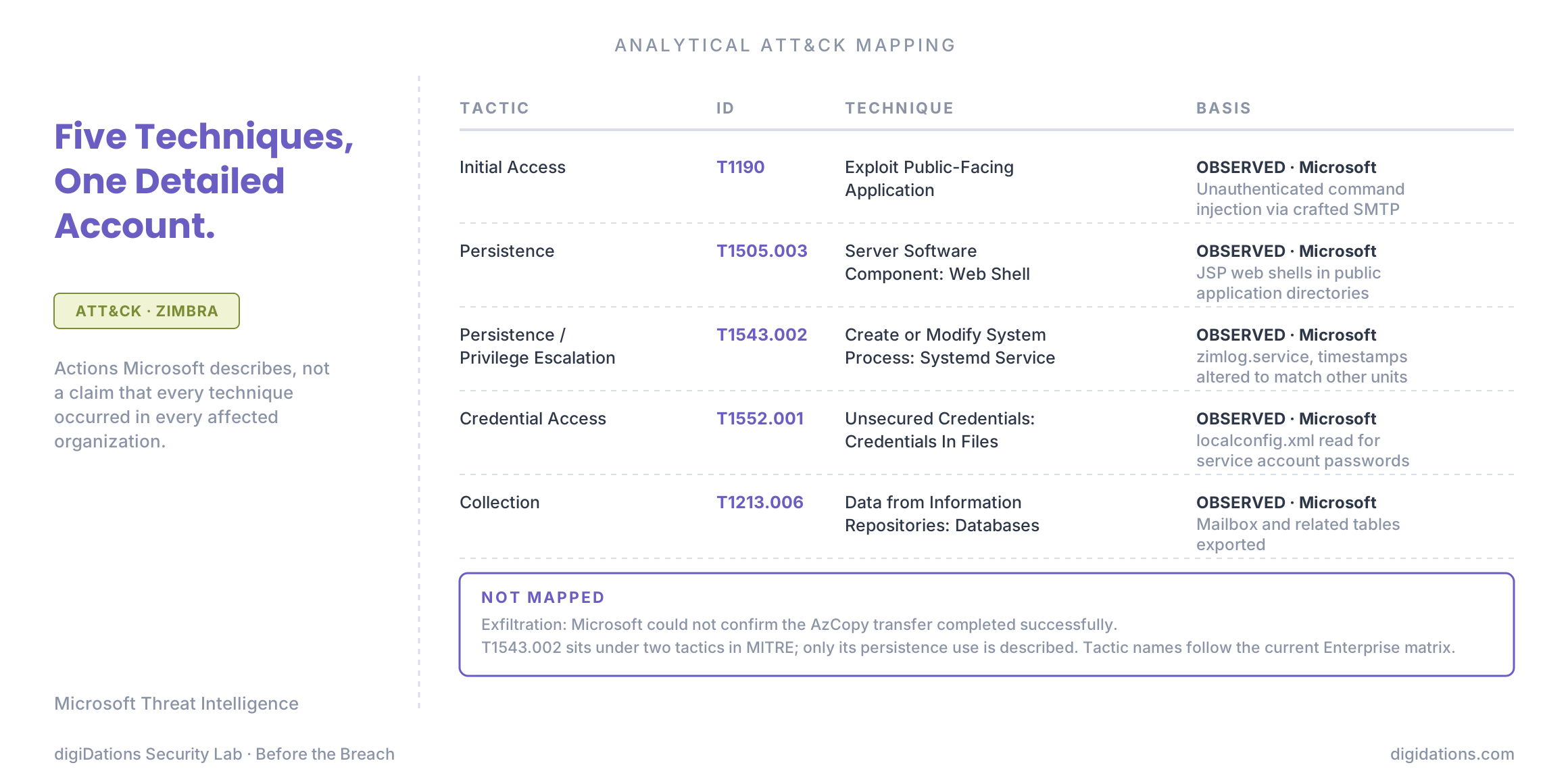
This is an analytical mapping of actions Microsoft describes, not a claim that every technique occurred across every affected organization. The vulnerability's unauthenticated exploitation maps to T1190; the observed web shells, systemd unit, credential access and database export map to T1505.003, T1543.002, T1552.001 and T1213.006. Exfiltration is not mapped as a completed action because Microsoft could not confirm the AzCopy transfer succeeded.
The Prevention Gap
Patching closes the vulnerable path, but it does not determine whether a server was compromised before the fix or what the actor accessed. In this case, detection depends on telemetry and rules for a mail server's normal behavior: a Java process launching shells or OpenSSL, JSP writes to application directories, unexpected systemd units, reads of localconfig.xml, unusual LDAP queries and bulk exports from mailbox tables.
Response also extends beyond replacing the server. Zimbra's mitigation guidance includes rotating zimbraPreAuthKey values. The observed access to service-account passwords and other authentication material makes it necessary to identify which credentials and keys were present, where else they are used, and how to revoke or rotate them.
What To Do Now
First, verify exposure and patch. Check Zimbra version, confirm whether zimbra-snmp is installed and whether SNMP notifications are enabled, and move affected systems to the fixed supported release.
Second, investigate before treating the upgrade as closure. Hunt for the artifacts Microsoft names: JSP web shells, zimlog.service, shell or OpenSSL processes launched by Zimbra's Java process, and access to configuration and mailbox data. Use the CISA forensic-triage flag as a prompt to check for prior compromise, not just patch status.
Third, scope and rotate credentials. Identify service-account passwords, LDAP secrets, Zimbra authentication keys and two-factor secrets available to the host. Revoke or rotate them, and assess any other systems or identities they could access.
Threat intelligence becomes operational when reported behaviors are translated into simulations. ATLAS™ uses a broad validation library to test whether customer controls detect, prevent and respond to realistic attacker activity. Access to detailed reporting like Microsoft's helps inform the behaviors and sequences represented in that library; broader coverage gives customers more of their control assumptions to test. These exercises validate control response to simulated activity, not whether this server was previously compromised.
HELIOS™ can help keep an inventory of internet-facing services current; it does not identify vulnerable versions or configurations. Neither platform replaces investigation of a suspected compromise or patching by the platform team.
The foothold was a mail-server vulnerability. The documented activity afterward was an effort to turn that foothold into access to the credentials and data beside the mail.